With everything in the United States that is corporate..there is a past history in the slave trade. Wall Street is no stranger to the dark past of "corporate America"..the Occupy Wall Street movement is a wonderful example of taking back a portion of America..that was built on the backs of slaves. Their movement goes to show that the 1% have worn out their welcome with the a generation that is no longer dumbed down to the hypocrisy of "trickle down economics" and the future will manifest itself inevitably.
The Dutch West India Company introduced slavery to New York (known then as New Netherland) in 1625 with the importation of eleven black slaves. These early slaves were put to work as farmers, fur traders, and builders. Some were used to build a wall to protect white settlers from the Native American population at the site of today's Wall Street in downtown Manhattan. Although enslaved, the Africans owned by the Dutch enjoyed a few basic rights. They could be admitted to the Dutch Reformed Church and married by its ministers. Their children could be baptized, and slave families were usually kept intact. Slaves could testify in court, sign legal documents, and bring civil actions against whites. Some slaves were permitted to work after hours earning wages equal to those paid to white workers. When the colony fell to the British in 1864, the Company freed all its slaves-thus establishing early on a nucleus of free African Americans in New York.
English slave laws in the colony were much harsher in comparison to Dutch slave laws. For one thing, slaves were considered chattel or property, and their enslavement ended only with their death or manumission. The earliest slave codes passed in 1664 defined slavery as an inherited racial status-meaning that the children of slaves were also slaves. New York slaveholders could inflict any punishment short of mutilation and death on their human property.
Freed blacks were also denied most civil rights under English rule. Any crime committed by a black against a white was severely punished, while white crimes against blacks were largely ignored.
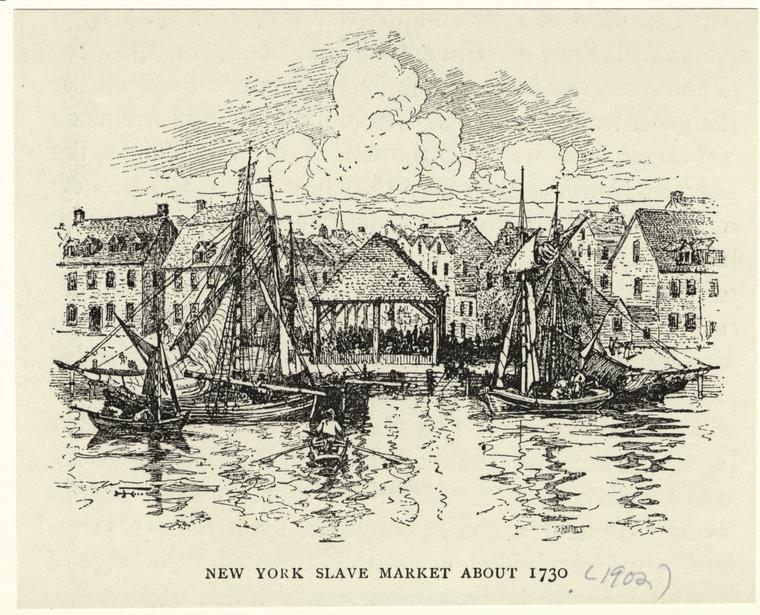
According to the first U.S. Census, the slave population in New York grew to 21,324 by 1790, making New York the largest slave-owning state north of the Mason Dixon line, a distinction it held throughout the two centuries the state practiced slavery. In New York City, a large percentage of the blacks were free-some 33 percent or 1,482 inhabitants by 1820. In the nearby rural area of King County, in what is present day Brooklyn, most of the blacks that lived there were slaves and worked as farm laborers. In New York City, on the other hand, one third of the black population worked as skilled artisans. Not only did many enslaved Africans live and work in New York prior to the American Revolution, New York City prospered as a thriving center of the slave trade. New York slaving ships made over 150 trips to Africa between 1715 and 1776. Most of the enslaved people brought to Manhattan were transported from New York after a brief time in port to the Caribbean or else to Virginia, the Carolinas, and Georgia.
As in other slave-holding states many of New York's earliest slave laws were motivated by the fear of a black rebellion against slavery, an apprehension that became reality in 1712 and 1741.
After a deadly slave revolt in New York City in 1712 that killed nine whites, stricter slave codes were passed. In putting down the upraising of several dozen enslaved people, the authorities executed 25 slaves. Of this group 20, including a woman, were hanged; three were burned to death-including one over a slow fire that lasted for eight hours; and one of the accused was strapped to a wheel and his bones broken with a heavy hammer. The colony's 1731 slave code was designed to regulate nearly every aspect of a slave's life from morning to nightfall. It stated that no more than three blacks could assemble on Sundays. They were also prohibited from carrying weapons and using city streets after dark unless accompanied by their master. Out of a fear that blacks were spreading disease in fruits and vegetables, the New York City Council prohibited slaves from selling their own produce at large public markets in 1740. These laws did not prevent the deadly episode of 1741, during which a series of fires broke out in the city. The white community took these fires to be an open slave rebellion, and in the end 13 blacks were burned at the stake, 16 others were hung along with four whites, and 71 were deported from the colony.
source
No comments:
Post a Comment
We appreciates all comments and fosters free speech, however, keep in mind that we have young readers who peruse our site. Having said that, please refrain from using profane language, and know that flaming will not be tolerated. Spam will not be tolerated.