HUFFPOST.COM REPORTS
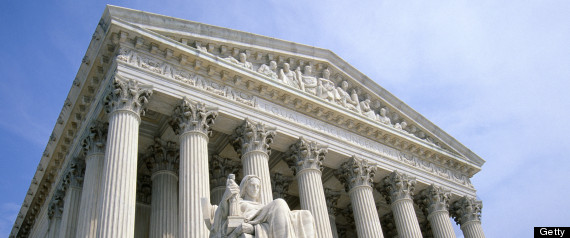
The Supreme Court struck down Section 4 of the Voting Rights Act on
Tuesday, the provision of the landmark civil rights law that designates
which parts of the country must have changes to their voting laws
cleared by the federal government or in federal court.
The 5-4 ruling, authored by Chief Justice John Roberts
joined by Justices Antonin Scalia, Anthony Kennedy, Clarence Thomas and
Samuel Alito, found that “things have changed dramatically” in the
South nearly 50 years after the Voting Rights Act was signed.
The court’s opinion said it did not strike down the act of Congress
“lightly,” and said it “took care to avoid ruling on the
constitutionality of the Voting Rights Act” in a separate case back in
2009. “Congress could have updated the coverage formula at that time,
but did not do so. Its failure to act leaves us today with no choice but
to declare [Section 4] unconstitutional. The formula in that section
can no longer be used as a basis for subjecting jurisdictions to
preclearance.”
Congress, the court ruled, “may draft another formula based on current conditions.”
“Our country has changed, and while any racial discrimination in
voting is too much, Congress must ensure that the legislation it passes
to remedy that problem speaks to current conditions,” the majority said.
“There is no doubt that these improvements are in large part because
of the Voting Rights Act. The Act has proved immensely successful at
redressing racial discrimination and integrating the voting process,"
Roberts wrote.
The court did not rule on Section 5 of the Voting Rights Act, the
preclearance requirement itself, which requires those affected states to
have changes to their voting laws cleared by the Justice Department or a
federal court in Washington, D.C., before they go into effect.
Nevertheless, Justice Ruth Bader Ginsburg issued a wide-ranging
dissent on behalf of herself and Justices Stephen Breyer, Sonia
Sotomayor, and Elena Kagan, justifying the continued vitality of the
Voting Rights Act's preclearance provision.
"The sad irony of today’s decision lies in its utter failure to grasp
why the VRA has proven effective," Ginsburg wrote. "The Court appears
to believe that the VRA’s success in eliminating the specific devices
extant in 1965 means that preclearance is no longer needed."
As for Section 4, Ginsburg wrote that "the record for the 2006
reauthorization makes abundantly clear [that] second-generation barriers
to minority voting rights have emerged in the covered jurisdictions as
attempted substitutes for the first-generation barriers that originally
triggered preclearance in those jurisdictions."
“The Supreme Court has effectively gutted one of the nation's most
important and effective civil rights laws,” Jon Greenbaum, chief counsel
for the Lawyers Committee on Civil Rights Under Law, said in a
statement. “Minority voters in places with a record of discrimination
are now at greater risk of being disenfranchised than they have been in
decades. Today's decision is a blow to democracy. Jurisdictions will be
able to enact policies which prevent minorities from voting, and the
only recourse these citizens will have will be expensive and
time-consuming litigation.”
In a concurring opinion, Justice Clarence Thomas reiterated his
belief that Section 5 is also unconstitutional, a position he took in
his dissent from the Court's previous encounter with the Voting Rights
Act in 2009.
"However one aggregates the data compiled by Congress, it cannot justify the considerable burdens created by §5," Thomas wrote.
The Obama Justice Department, believing the court might strike down Section 5 of the Voting Rights Act in 2009, devised a plan to react to the ruling. A Justice Department spokeswoman did not immediately respond to a request for comment Tuesday.


No comments:
Post a Comment
We appreciates all comments and fosters free speech, however, keep in mind that we have young readers who peruse our site. Having said that, please refrain from using profane language, and know that flaming will not be tolerated. Spam will not be tolerated.